Monday, December 19, 2011

That's Just Offal

If pressured, I would admit that I don't really believe eating every part of the animal has anything to do with being moral. In fact, so long as the animal has had a good life, eating the parts which are most delicious to you seems like a fitting tribute. Animals, after all, are animals, whatever the quasi-religious left-wing animal rightists, or the even more quasi-religious right-wing hunters, may feel. But, as an eater, some of the best meals of my life have involved cuts decidedly not from the tenderloin/backstrap (in point of fact, tenderloin has never been very enjoyable or flavorful).

Some examples:

-Pho with soft tendon, a meltingly tender mouthful of beef essence
-My first menudo, a soup so perfect I keep chasing it to the bottom of skanky bowl after skanky bowl
-Foie gras, on the line at Au Pied de Cochon; never have the words, "ere, heat this" sounded so right
-Tongue tacos, everyday, anytime

As an anachronist and a minimalist, there is a strong drive to eat the whole animal because not wasting anything is the way it's always been done.

But, chiefly, as a cook, throwing a piece of prime strip on a hot grill with a bunch of salt is boring. What has been done, other than salting the meat and flipping it? There's no challenge, and for a while, my disillusionment with that ease allowed me no joy in cooking with meat of any kind.

One of my vividest memories of Montreal is peeling, with a vegetable peeler, braised venison tongues in the sweltering prep cellar. There was an element of medieval torture (deer are very similarly sized to humans, and the tongues I held were roughly the same shape as mine), but there was also a great deal of skill and knowledge involved. A tongue takes some care to make edible, but when done right, it is true bliss (and at Au Pied de Cochon, the tongues were most definitely destroyed by being soaked in vinegar).


--
Thursday: Tongue and Tail

Nose-to-tail eating can get only so much more literal than this.

Hugh Fearnley-Whittingstall is my favorite cookbook author, although his recipes aren't the most daring or technically precise or even authentic. Still, he embraces food as food should be embraced: honestly, for what it is, and for what it does to us. A pig, to him, is not a source of excessive culinary creation (like Martin Picard) or traditional nasty bits (such as Henderson), but a pig, as in that animal which lives outside his farmhouse, eating scraps from the garden, and in the fall eats fallen acorns in the oak stand along the hedgerow. A pig, quite simply, is more real to Mr. Fearnley-Whittingstall than to any other author I've read. Only Rob Levitt, of Chicago's Butcher and Larder, approaches meat, with a similar mindset (and the mindset, by definition, extends beyond meat to all food, but that is outside the scope of this week's cooking).

This dish intrigued me. Tongue is one of my favorite cuts, and oxtail is a newly discovered delight. So what would they be like, jellied in a loaf with red wine?

Really, really good.

The chunks of meat were too large, and the loaf came apart when I sliced it. Such are the results of making an aspic loaf for the first time. It was also too rich to eat much of it in a sitting, but when it was hot and served over parsnips...


Absolutely soul-warming. Just what I needed when my family were out of town.


---
Friday: Tripe

Rarely do I find any food unappetizing. From youngest childhood to now, almost nothing served has made me gag. There have been two, maybe three, times in my life when I simply could not chew - an oyster when I was 4 (which I don't remember), a vegetable terrine in France. One of those times was this last Friday.

Entranced with the romantic portrait Henderson painted on page 88, I decided to make my second dish Tripe and Onions. The second chamber of the cow's stomach is no stranger, with menudo being a favorite meal of mine. Sure, there have been a bad experiences, but in general, the melting quality of the tripe and the spice of the broth combine to be the most perfect accompaniment to masa.

Still, there is an element of revulsion in those memories. The texture of tripe is off-putting to Americans, but the smell is what dominates. At one moment, it is the most homely, warming aroma I know, but there is a strong part of it which disgusts me. As much as I love menudo, the smell and texture have always left me wondering if this was the time I would lose my lunch while still eating.

In the end, it was not menudo, but a warm, comforting dish of English heritage which put me over the edge. Had this tripe been grass-fed, sourced by St. Johns, served in the white-tiled dining room, by respectable waiters, and simmered for hours by their knowledgeable cooks, it surely would have been divine.


But just look at that pile of squishy yellowish goo. I put it in my mouth and gagged. Gathering will power, I bit down and didn't gag. I bit down a second time, and gagged harder. I spit it out, and gagged. I made it to the sink, and while not gagging, I could feel muscles lower down contracting. This, I thought, was surely my stomach staging a protest. No stomach shall be digested by this stomach, it urged.

So, my second meal was a failure, but I am determined now. Between now and the next time my family leaves me alone to my own devices, I shall eat as much tripe as possible, so that the smell of it cooking does not induce panic at the thought of actually eating it.

Or maybe I'll just throw in the towel and stick to less emetic offal (like liver, and kidneys, and hearts (which really isn't offal at all)).
--
Saturday: Old stand-bys: roast chicken with golden beets and parsnips, and wine-braised sauerkraut. Recipes I know well, and that can be ready with minimal prep, which was good for having a couple guys over. I only mention it to explain why I didn't make anything spectacularly disgusting.
--
Sunday/Monday: Trotters

Le ragoût de pattes de cochon is a traditional Christmas dish in Quebec. (I'm assuming it was eaten more widely than the end of December, but the last 50 years have seen much of the poor rural element give way to a slightly wealthier eating style.) A confession: trotters are not what I would call "edible" or in any way pleasing. I am old enough, and I've eaten enough with a completely open mind, that I feel no embarrassment saying that gnawing through skin to get to cartilage which is surrounded by fat is not pleasant.

But, sometimes, you have got to do something because two days before, you made something even less enjoyable because of some romantic and foolish idea that tripe only needs respect to taste good.

Besides, I cooked at the current spiritual home of Quebec cuisine, and I was using that recipe. I had to do this.

This dish took three days to prepare. I roasted a chicken on Saturday to serve for dinner, then on Sunday used the carcass to make a simple chicken stock with carrots, while brining the pig's feet. The original recipe called for pork stock, but this is a dish from Quebec, and les habitants are nothing if not frugal, so I felt that the chicken stock was more fitting than buying more pork to make the stock with would be. Then, after the stock was made (around 2:00 pm), I put in the trotters to simmer for three hours.

This recipe also has one of the weirdest techniques I know, and it isn't just Martin Picard's insanity. The sauce is thickened with flour, but first the flour is roasted in a 400 degree oven until dark brown. There's no fat added to the flour, so it isn't a roux, nor is it mixed with anything else. It's just oven-roasted flour, which smells rather strange. My only hunch is that this is an ancient French technique which died out on the continent sometime between 1700 and 1900 with the universal adoption of the roux, but which persisted in the francophone enclave of North America.


So, that was all done on Sunday, and the stock with trotters was put in the fridge overnight.

Look at that gel! God, trotters are amazing.


As that heated up on the stove, I prepared the meatballs, which are seasoned with nutmeg, cinnamon, clove, and pepper, then browned them in a skillet with some of the schmaltz the great cooks at work gave me (they gave me a quart of schmaltz for no reason other than I asked). I reduced the broth while cooking the meatballs through in it, and then put in some fingerling Yukon Gold and boiler onions. Unsurprisingly, given the pork, cinnamon, and clove, it smelled a lot like pho until the potatoes took over.

Finally, I added the roasted flour to the broth, then reheated all of the ingredients in the sauce: the trotters, the meatballs, the potatoes, and the onions. I took them out, and then mounted it, because this is a good dish, a French dish, and what the hell else would you do after cooking pig's feet and meatballs browned in schmaltz in the gelatinous pork/chicken stock, other than melt butter into it?

Here it is:


I took a bite and... best thing I have eaten in months! I was reminded that when I first started at Au Pied de Cochon, I loved the trotters. It wasn't until I picked the bones out of 40 a night that my stomach started to turn. Trotters are a glutton's fantasy, and could only be improved by being stuffed with foie gras (incidentally, the signature dish at Au Pied de Cochon is just that). The stew was hearty, familiar, and yet exotic. It was rich and luxurious, yet plebeian. The roasted flour, by the way, gave it an intriguing, alluring depth.


So, to all of you, a very happy Christmas!

Sunday, May 8, 2011

Rice Cooking

My previous post (the one about oden, which was actually written and posted after the braised oxtail post, but Blogger strangely relegated it to January 31) was my foray into Japanese cooking, but it is a topic with which I have become quite familiar. As I learned more over the past few months, partly because of my cooking colleagues at the restaurant, and partly through obsessive reading of cookbooks and blogs, the simplicity of the cuisine has really stuck hard in my mind.

One thing which I've become very interested in is onigiri. They're basically rice balls, often formed into triangles or pyramids, filled with a savory bite, and then wrapped in nori. I've been cooking a lot of rice for these, and perfecting my rice cooking has become a bit of an obsession. My rice is better than at any time since living in the apartment in St. Peter, when I ate beans and rice twice a day for four months (those were the days!). The idea of waking up to a steaming pot of rice, too, has become very attractive, so I've been looking into programmable rice cookers.

I stumbled across Adventures in Bentomaking, a site run by a Hawaiian woman and mother, while researching rice cookers. Zojirushi is generally considered to be the best brand available in the US, and she was reviewing a new model they released which claims to enhance the umami characteristics through its cooking method. Amazingly, Zojirushi has offered to give one of her readers a rice cooker to test, too, and you can read about how to enter on her site. Needless to say, I have entered, and if I am selected, there will be many posts about onigiri, shari, and also experimentation of all sorts (I am, after all, a former professional cook at two very good and inventive restaurants; I think I can come up with some unique ways to use the rice cooker).

At any rate, a rice cooker is definitely in my future. Although Japanese white rice is a newly acquired taste at home, brown rice has consistently been one of my staples, served with a plethora of legumes. It's going to get a lot of use, now that my job will require something of a commute.

Monday, January 31, 2011

Red Wine Braised Oxtails

A friend of mine sent me a recipe around Thanksgiving for braised oxtails. Life got crazy, and before I knew it, my mom's family was visiting for Christmas. Aha! I thought to myself, now is the perfect time to try this recipe.

A time-intensive labor of love it was: first, I made a beef stock from scratch, which took a day and a half. I then had to braise the oxtails, which was another day, plus the two days it took me to source the oxtails themselves. (On a side note: I called the Northbrook Whole Foods to see if they had the oxtails and was told they did. I took an hour detour specifically to go by the store, and once inside, found out that they had no oxtails. WTF? One of the two people I spoke to had made a mistake, and it pissed me off so much that I will never return to that store for any reason. I ended up going to Little Mexico to track down the oxtails, and they were not free-range, grass-finished beef.)

So, more than 24 hours went into this dish, and it showed in the end result. Meltingly succulent oxtail was enveloped in a thick sauce made from reduced stock and red wine. I had plans to serve the oxtails with a beautifully smooth purée of root vegetables and a tart cranberry compote to cut the richness, but then reality struck: no one would eat oxtails.

Well, phooey! This was one of the richest, most decadent dishes I have made at home, a dish through which the beauty of peasant food (poor people making good food out of the scraps because they had to) shined in all its beauty. The dish was refined, yet also comforting, and represented what "cooking with heart" is all about.

So, I was forced to gnaw on the bones for a couple days. I'll leave you with this glory shot of the stock, one of many magnificent pieces of this dish that, unfortunately, no one else got to enjoy.


What Am I Doing?

Maybe it was the oxtail fiasco, which consumed 24 hours of my life and then no one wanted to eat it, or maybe it was the experience (yes, experience) of finally enjoying tonkatsu ramen. More likely, it was too many late nights watching Iron Chef reruns. I'm not totally sure, but I have recently lost my inhibition against making Asian food at home, or more specifically, I have become enamored with the idea of making homemade dashi.

What is dashi, you ask? I had no idea until the beginning of December. It's Japanese stock, is what it is, as foundational to Japanese cuisine as veal stock is to classical French cooking and water is to the Italians. I haven't been able to figure out when certain dashi are used over others, but the most commonly referenced one, the one I have become enamored with, is a simple stock made from simmering kombu (a type of seaweed) with bonito flakes (shavings from a piece of dried tuna). (For those sad, pathetic souls who are familiar with Iron Chef, Rokusaburo Michiba's "broth of vigor" is a very strong version of this.)

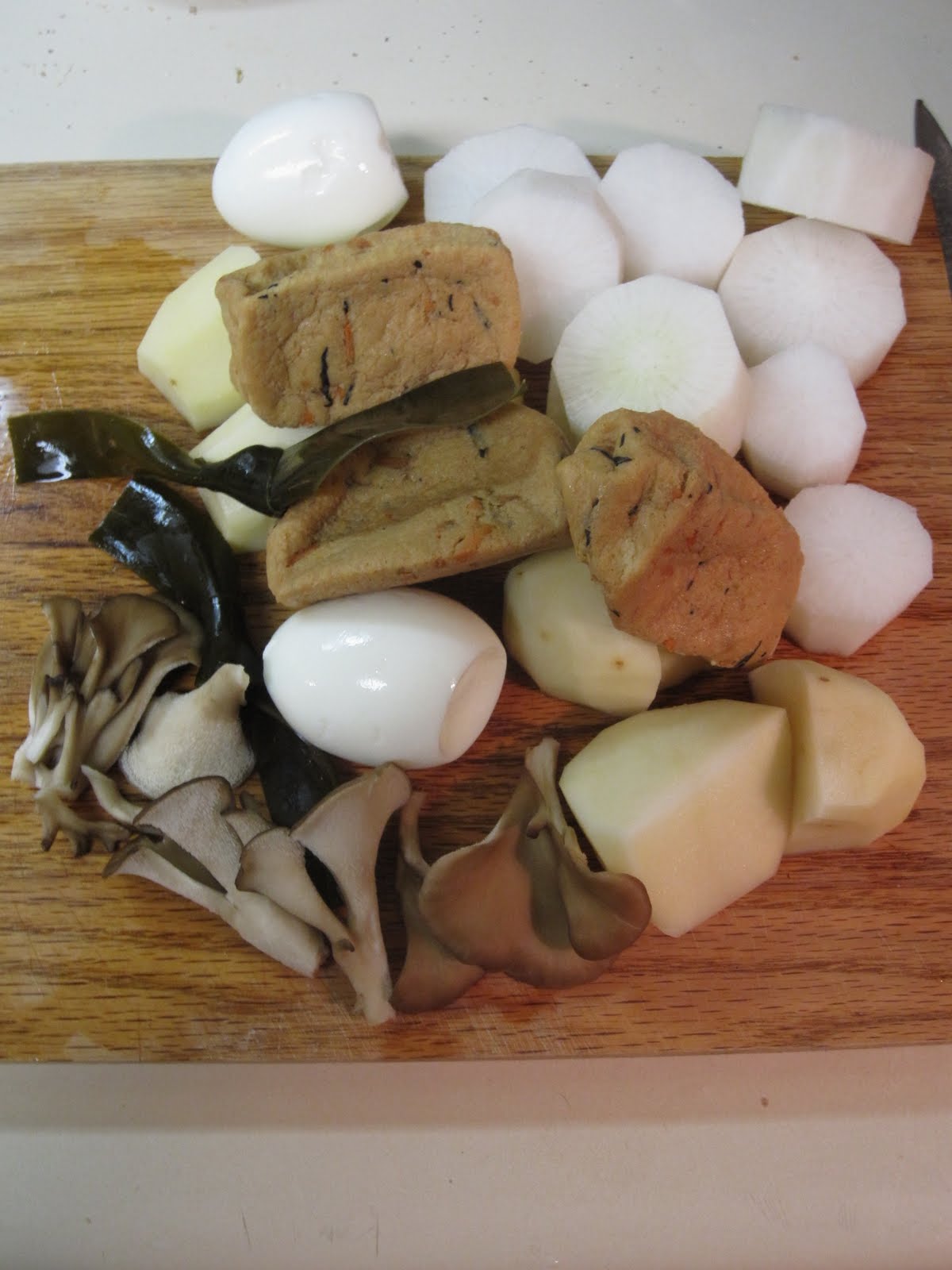
To that end, I swung by Mitsuwa today and picked up some ingredients to try my hand at a common wintertime dish utilizing dashi: oden. Oden [Wikipedia article here] is both familiar and exotic, an immediately recognizable melange of hot broth and root vegetables, but dosed with fish cakes and fried tofu fritters. This dish, I decided, was the one to cut my dashi teeth on.

Of course, all I knew of dashi making were a few 3-second clips of Michiba dumping bonito into a weird pot of boiling...water? So, the first thing I did was Google dashi, which led me to UmamiMART's page on the subject [link]. Using this and the TV show as a guide, I started.

Here's the kombu at first.


And after a twenty-minute soak.


The bonito flakes being added to steaming water. (I nibbled on the bonito a little. Let me just say, bonito flakes will probably be a pantry staple for me in the future.)


At this point, I let the water come to a boil, then turned off the heat and let everything steep together for about half an hour. Then I strained the dashi through a paper towel set in a fine mesh strainer, and I had about a quart of dashi. Super simple to make, much easier than a classical French stock. How did it taste? Um... Japanese? It was strong and simple, but the bonito is a very complex flavor. Definitely, this dashi could be worth the trouble (which was really minimal, about five minutes of actual work).

So, on to the oden; going into this, I decided that if the oden was terrible, or at the least not worth the effort of making it, I really didn't have any reason to try dashi again. Well, the oden was simple, at least. I peeled and cut up a couple smallish potatoes and a large daikon, some maitake mushrooms (not traditional), then added those together with some tofu fritters and hard-boiled eggs to the pot. I also took the kombu out, sliced it into ribbons, and tied it in a simple overhand knot, which I either made up or else is traditional. I had read that you're supposed to par-boil everything first, but this was the first time I made this dish, and I had never eaten it before, so I figured, what the heck? No time like a first try to mess up and not feel bad about it. I also added a tablespoon or so of soy sauce.


So, here it is with everything added to the pot. I added enough dashi to cover everything comfortably, with the idea that it would slowly simmer down to a more concentrated broth. (It did not, because I covered it.)


Here it is after an hour on the stove, when I served it. Over the course of simmering, the smell changed from one dominated by the bonito to one dominated by a combination of the seaweed and the radish.


How was it?

I liked it. A lot. As with all Asian food, the flavor profile was foreign but not bad, and the texture of the tofu fritter was surprisingly spongelike. All told, I would definitely make this again, although I might not have a chance for a couple winters. It was pretty cool, though, having my home smell like Sushi Kushi Toyo.

Monday, December 13, 2010

New Years' Eve

I'm finally doing it: shelling out for a prix-fixe dinner on December 31. I've never tried Avec, and after their run-in with bad luck, this year seemed like the perfect time to do it.

Good news: skatewing's on the menu.

Sunday, October 3, 2010

Essay Contest

Anthony Bourdain's new book, Medium Raw, is being published in paperback, and he's decided to publish a short essay by an unpublished author in it, as a sort of way to pay forward the surprise success he enjoyed ten years ago.

My submission can be found here: The Deer and La Lengua. Read it, vote for it if so moved, and please above all leave an honest comment.

Matthew

Friday, July 30, 2010

In Memory of an Artisan

I only met Daniel once, about six weeks ago. I had gone down to Prairie Fruits Farm for the weekend for reasons that now seem cloudy, although I think the idea had been to talk to Leslie and her husband Wes about getting involved with the Chicago farmer's markets. Almost as soon as I arrived, I was told of a new vendor next to them at the market, a young man who'd followed his passion for bean-to-bar chocolate to starting his own business - Flatlander Chocolate. They were, believe me, absolutely incredible.

He also made caramels, and I'd tried to buy a salted one from him when I was there. Unfortunately, I'd waited too long, and he'd sold out. "Next week," he assured me with a smile. Of course, I couldn't make it to the market the next week, but I'd hoped to go down to the farm again, sometime this summer, and get one then.

Daniel was 24, and had been a graduate student in computer science (or maybe it was mathematics) at UIUC when he'd started playing around in the kitchen with cocoa nibs. Eventually, the hobby became an all-consuming passion, and he left school to pursue his chocolate-making full-time. When I was a the market, his zeal bubbled out from under his awning. He was a very charismatic young man, tall and thin, with a hipster edge. I both related to him and admired him for taking the leap and pursuing his passion full-time.

Daniel died Tuesday morning, an apparent suicide. The news out of Urbana is sketchy at best, but I have to admit, I find it hard to understand how someone who took such glee in his work could also be desperate enough to kill himself. But, of course, I only met him once, briefly, and our conversation never turned to matters of the heart or mind.

Saturday, July 17, 2010

Caliente Doug's


I had an epic day of sexploration yesterday, by which I mean I ate a lot of really good food. The first stop was the always disappointing Hot Doug's. Seriously, could there be a place - anywhere on the planet - more overrated? Above is a picture of the entranceway, a picture that took two hours to get. That's right, two hours of standing in line to get a couple decent sausages.

I ordered the Keira Knightley and the infamous (and rather heroic) foie gras and Sauternes duck sausage (with truffle oil sauce). Those are pictured below, along with the pommes frites en gras de canard, i.e. duck fat fries. I'll let you in on a little secret: Pied de Cochon's fries were cooked in only 50% duck fat and theirs were a lot better. I'll let you in on another little secret: Pdc's fries are only about as good as Nightwood's.


This sausage, however, was a work of art. It was a rib-eye sausage with black garlic aïoli and a double cream Brie. Not worth the wait, but definitely worth eating.


Following a few hours' cooling off in front of HGTV (I was the only guy, that's my excuse), we headed to get some dinner. Xoco was our destination, a place that I have been eager to try since last summer, despite a slightly blah review from a trusted source. Those in the know will be aware that Xoco is Rick Bayless' sandwich shop, serving tortas and soups for lunch and dinner, but also serving coffee, churros, and the most amazing hot chocolate on this side of the Atlantic. It's at Illinois and Clark, right next to Frontera Grill, and words and images really don't do it justice. Just go there.


The tortas we shared were a Yucatecan-style pork offering, called cochinita pibil, with the ubiquitous pickled onions on the side and a fiery (but sooooo delicoius) roasted habanero salso. This one is on the left in the picture. The other was a daily special of shrimp and bacalao (it being Friday), and it was simply good. The bacalao hadn't been oversoaked, neither had it (crucially) been undersoaked. Just two very well-conceived tortas. The chocolate, their Barcelona offering, was just bittersweet chocolate heaven.

All in all, an amazing day. Now I get to get up at 4:30 tomorrow and cook my own amazing food. Cheers.

Thursday, July 1, 2010

Happy Food Independence Day!


Here's a picture of an organic-egg-in-the-whole-wheat-basket. (The bread is from the Great Harvest in Evanston. So good!)

Thursday, June 24, 2010

Pasta con pomodoro


What an exciting time of the year! I love the summer solstice. The excitement of the coming growing season reaches its fever pitch right now, at least for me, just as the days reach their longest. Today, I took perhaps the last chance I'll have for a while to spend a few hours in the kitchen making dinner. I've been working on homemade pasta for a while, and it finally came out the way I wanted it.

Fresh pasta's a wonder to make, super simple: a cup of flour, two eggs, mix into a dough and then knead for ten minutes until it becomes like silk. Let it rest for ten, and then roll it thin (I mean THIN). Cut it into strips, then cook in salted boiling water for a few minutes. The pasta comes out delicate, with just enough bite. For this, i cut very wide strips, more than an inch. In the future, I'd probably cut it a little narrower, but the wide noodles worked well for this sauce.

Speaking of sauce, it couldn't have been easier. Into a hot pan, I put a few tablespoons of olive oil, chili flakes, salt and three cloves of garlic, sliced thinly. I cooked that for a bit, but before the garlic browned, I added a can of San Marzano tomatoes. For me, the flavor of that tomato was really key for this dish, so while Romas or Beefsteaks, or even fresh tomatoes, would work, they wouldn't work as well. I seeded them, too. The sauce simmered while I made the pasta, probably about half an hour. The tomatoes softened enough that they could be broken up with the side of a spoon, and then I finished the sauce with torn fresh basil.


Finally, because pasta with tomato sauce, as delicious as it may be, does not a full meal make, I made tonno e fagioli. Using canned cannellini beans, I made a dressing with about three tablespoons of very good extra virgin olive oil and a tablespoon of lemon juice, two minced cloves of garlic, salt, and freshly ground pepper. I mixed in the can of beans, and then added a can of tuna. After resting in the fridge for the flavors to meld, it made a perfect accompaniment, although it could have used some parsley (if for nothing else than color) and honestly the lemon juice would maybe have been best replaced with red wine vinegar.


So that was the meal.

Thursday, June 17, 2010

Black Bean Chili


Usually, I'm not one to care about the presentation of my food. Well, that's not exactly true, but I usually go for a rustic esthetic, which reflects the flavors of my food: bold dishes, even when they are light (like risotto), the food could be easily found at a restaurant called Peasant Food.

But, Gordon Ramsay made a soup on a show a few weeks ago and it gave me an idea for tonight's dinner. One of my favorite dishes to make, because of its simplicity and almost boundless deliciousness, is black beans. Slowly cooked with onions, a large amount of cumin and an even larger amount of chili powder, I often render fat from bacon to soften the onions in and add it all to the pot. It creates a savory and aromatic dish worthy of a cattle ranch in southern Texas. Seeing the Ramsay bean soup, however, made me wonder: could I turn that bean dish into a delicate soup?

The first step was to cook the beans. Since I wanted a lighter flavor than usual, I softened the onions (about one and a half small yellow onions) in olive oil (instead of the rendered fat of salted pork belly). I added some beans, not a lot as you can see from the finished soup picture below, and then covered them with sufficient water to end with a fairly thick soup. I'm not sure how much of either, but it was probably two and a half cups or three of water, and maybe three handfuls of black beans. They were dry is all I know. I brought the mixture to the boil, dropped it to a light simmer, and then added about a tablespoon of cumin, four teaspoons of chili powder, and a bay leaf, then simmered until the beans were done, which took about the second half of the Mexico-France World Cup match.

When it was done, the beans were soft without any hard bits inside, I spooned out maybe two tablespoons of the beans, trying to make sure they were whole and their skins hadn't ruptured. Then, I pureed the rest, with cooking liquid. I added some salt (since this is a posh dish, I went with Kilauea sea salt, the black one with a deep flavor), and drizzled in high quality olive oil until the mixture was smooth and looked satiny (probably a tablespoon or so). And then I put it back in the pot to await dinner. Below, you can see a picture of the soup base. I should note, I took out the bay leaf before pureeing.


So, on to the garnish. I wanted a contrast of flavors between the soup and the garnish, but not something absurd like strawberries and cream or even fried plantains (although that would be great as a garnish!). Instead, I wanted some flavors that I would normally include in beans and rice, but decided not to include in the soup base to maintain its lightness. I fried some pancetta, and crumbled it, then carefully diced a large shallot (I think the pieces of shallot should be smaller than the black beans, but you don't want a mince). Finally, I mixed in a little lime juice, salt and pepper to taste. Below, you can see the garnish in its little bowl.


However, since this whole preparation, which I've been making for years, was inspired by my mom's vegetarian black bean chili, and that is always served with cornbread, the dish wasn't finished. Anyone who's eaten at a top restaurant knows that there has to be some ridiculous, crunchy accompaniment to a soup, one which is supposed to add a flavor note of nostalgia, bringing the whole dish back to its humble roots, but usually just ends up being a rather flavorless piece of an otherwise brilliant soup. So, I made crispy cornmeal pancakes, which were awesome when I tried them on their own, but probably weren't nearly as awesome with the soup as I wanted them to be. It was fairly simple: I poured hot water over cornmeal to hydrate it, then mixed in salt, some honey, melted butter, then turned it out on a hot griddle and cooked them until they were browned on both sides. It was a brilliant piece of a...oh, whatever. Here's a picture.


And it did taste almost exactly like the cornbread my mom used to make without taking any real amount of cornmeal or time.


To serve, I reheated the soup base, ladled it into a bowl, then topped it with a little mound of the garnish, as you can see above, it came out quite beautiful. Unfortunately, it tasted horrible. (Psych!) Honestly, this is probably the most balanced dish I've made to date. The soup base itself had a rich texture, with a strong foretaste of black beans, accented with cumin and a small taste of chilies. The olive oil left a nice buttery feel on the palate, and there was a lingering bitterness, too. All in all, fabulous!

There isn't much that could improve it, either (well, save the cornbread). Some hot pepper would have been nice in the garnish, and it would also have been nice to have more garnish than I made (read: save more beans before pureeing), but it was still an excellent meal. Of course, it would be easy to make vegetarian (or even vegan), since the only meat in the entire dish was the pancetta in the garnish, and a garnish of onion, pepper, cilantro (or epazote!), and beans would go just as well. The lime juice really brightened it up, too, although I'd probably leave that out on a day colder than about 75.

Tuesday, June 8, 2010

Caldo de Res Revisited

One of the few joys of unemployment (entering its third month now) is that I now have the time to spend 20 hours on one dish. This is the sort of luxury usually left for those either too old or too busy (read: restaurant cooks) to fully enjoy it.

Here is the stock, minutes after adding the mire-poix, cilantro, jalapeño, and tomato paste (but after the meat bone had simmered for about 10 hours).


That wonderful mess of fresh vegetables, with a noticeable red hue (well, maybe not that noticeable), would become (some four hours later) this masterpiece of Mexican simplicity.


My favorite soup, made from scratch.

Saturday, June 5, 2010

Onion Soup


Wow, only a month and a day since my last post! There's been a lot of cooking going on, and I have some exciting stuff going on right now, but that'll have to wait for a later post. Hopefully, though, I will have more pics like this to share

So, the point of this post is to go over one of my absolute favorite dishes: the bistro classic French onion soup. The standard preparation is to caramelize onions in butter, then add beef stock and perhaps a little red wine and cook. Occasionally, in American recipes you'll find the soup thickened with flour, but the classic dish has a thin broth given body by the gelatin in the stock. (A well-made stock, using bones, is one of the most amazing things I know of to cook with, but that is a completely different post for another day.)

However, years ago, when my cooking skills were nascent at best, I read a brief mention in a Cook's Illustrated recipe of a French chef once preparing onion soup for the test kitchen where the only ingredients were onions, salt, pepper, and water. He spent hours building up a fond on the bottom of the pan, then deglazing with water, and repeating until the onions had softened to a dark color. The simplicity of the preparation really appeal to me, and I've made it a couple times. Let me tell you: the results are spectacular. The depth of flavor gives nothing away, but it is a time-consuming dish and requires - REQUIRES - a thick-bottomed pan: cast iron, copper, All-Clad. If you don't have a pan that strains the wrist when lifting it, don't even bother attempting this.

Because the key to this dish is low heat and patience.

Today, I experimented with a few things: pancetta, white wine deglaze, red wine deglaze, and tomato paste (aw yeah!). But I want to stress that what follows can be done using only water and onions, with some butter, and therefore can be an incredibly hearty and entirely vegetarian winter soup. Never mind that it's June 5th. With that, let's get on with it.

The first step, done last night, was to slice three pounds of onions. Then, I cut lardons from about a fifth of a pound of pancetta, rendered their fat, then removed them from the pot and added the onions. Below is a picture of the pancetta browning, with the onions in a bowl behind.


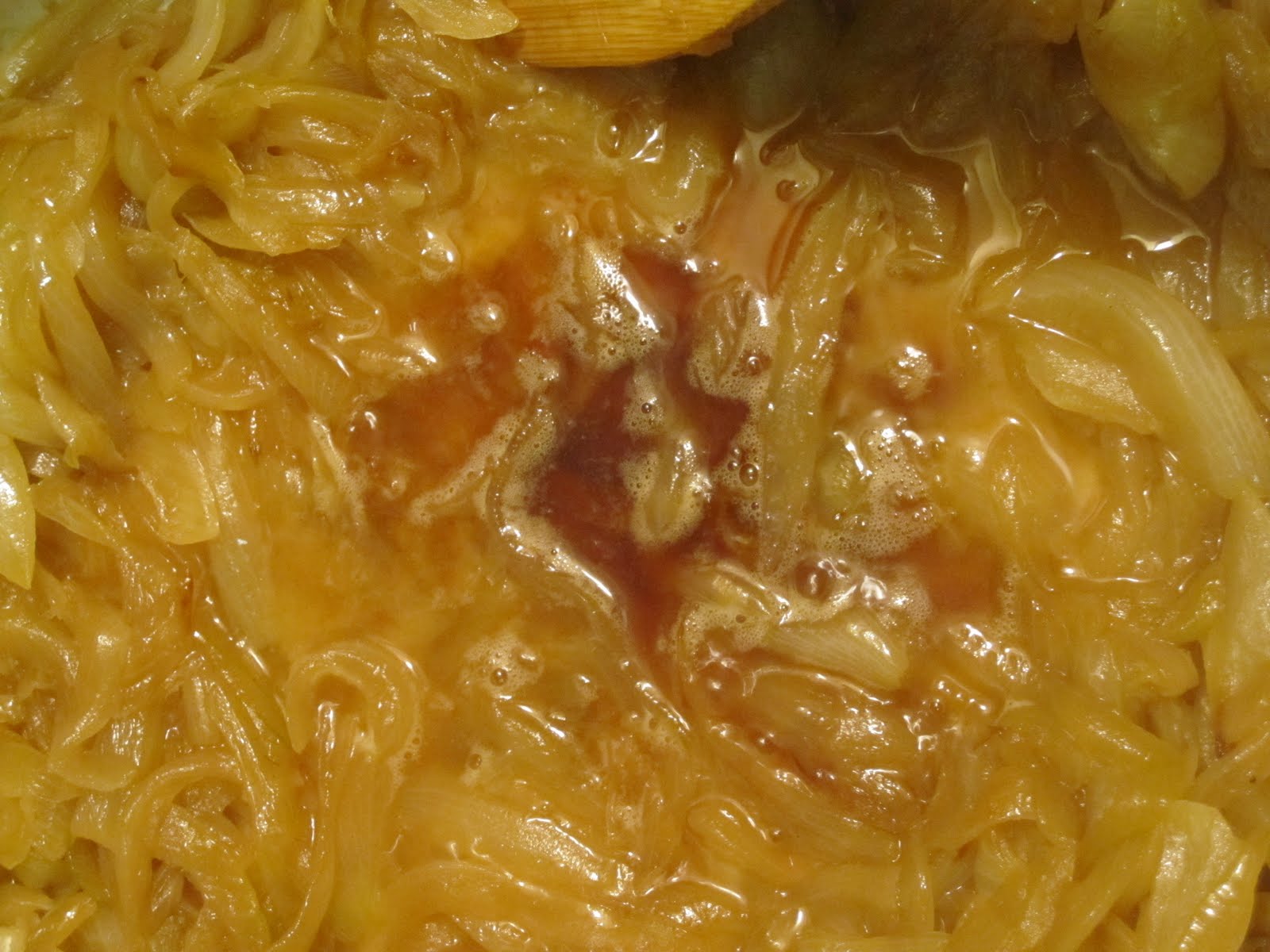
The onions were added, and softened over medium-low heat until a fond had formed. This takes a while, since the onions have to soften and their moisture cook out before the Maillard reaction can occur and develop that beautiful fond. Fond, in case you don't know, refers to the brown bits that form on the bottom of a pan. Le fond, in French, refers to stock, though, so don't act like you know anything now.


Once the first fond formed, I deglazed with six ounces of white wine. Deglazing just means pouring a liquid into the pan and boiling it to dissolve the fond in the liquid. At this point, I refilled the glass with six ounces of water, set it next to the pot, and waited until a fond formed again. I then added just enough water to deglaze the pot and a generous pinch of salt. In all, the six ounces of water allowed for eight deglazings. That took about two hours, but since my pan is a thick-bottomed cast iron masterpiece, it took very little attention from me. I'd check the pan about every five minutes and when the fond looked like the one below, I'd deglaze it.


Just before the final deglazing, I added about two teaspoons of roughly cracked black pepper and a bay leaf. Then, I deglazed with six ounces of red wine. This, as with the white wine before, is completely optional, although both wines do add a lot of flavor and some body.


I boiled off the alcohol, then added enough water to make it look like onion soup along with a tablespoon of tomato paste (aw yeah!), brought it to the simmer, and let it go for about half an hour.


The harsh flavor mellowed and came together beautifully and the broth gained body during the simmer, but my final tasting (or what I was hoping would be my final tasting) told me that the sweetness of the onions was way too strong and the salt had done as much as it was going to do. So, I squeezed a little lemon juice in to cut that sweetness, then let it simmer for five more minutes so the soup didn't taste like I'd just squeezed lemon juice into it.

Top it off with a broiled crouton with Gruyère on top and there it is: three-hour, four ingredient (five, six, seven, whatever, they're optional) onion soup.

Tuesday, May 4, 2010

Skating down the Wing

It is May, which means the return of the Stanley Cup playoffs, the greatest* annual sporting competition. This post, however, is not about that. Rather, it is about overcoming my fears and discovering something truly magical.

I have always been afraid to cook seafood.

This may seem strange. Rarely has a preparation intimidated me. My first mayonnaise was made, without breaking, only minutes after reading a recipe. I dove headfirst into breadmaking, only to discover that it is not nearly so hard as a Quebecer's head. And how many complicated curries did I merely laugh at before attempting to butcher in many painful ways?

Seafood, however, has always been an exception. Living in the Midwest, it is hard to get fresh fish, so I decided to only indulge when on the coasts. Since it was a treat, I left it for professionals to prepare it, which eventually turned into a slight hesitation to prepare it myself, and this state of affairs eventually (and quickly) spiraled into a full blown apprehension towards cooking fish and other seafood. The only thing I have prepared in recent years is ceviche, and only because it is both mind-blowingly simple and stupidly delicious.

For whatever reason, on Sunday, I jumped. On a heart's fancy, I talked my mom into trying out a fishmonger in Lake Bluff, and the fishmonger suggested I try skate wing. To make a long story short, the skate wing was very thinly filleted, so I pan fried it for just a few minutes on each side, made a pan sauce with white wine and parsley, and served it for dinner. The fish was so undercooked, it may as well have been sushi.

What?

I had always heard that fish hated overcooking. The number one rule is to err on the side of undercooking. And this was a very thin filet, cooked for not a very short amount of time. It made absolutely no sense.

The fishmonger had given us three of the skate wings. Two had been prepared. Monday morning, I went online and did some research and found out something rather surprising: Skate wing, as well as monkfish, like to be cooked for a long time. In fact, the longer the better, within reason.

Cue second attempt: same pan, more butter, longer cooking time. Much longer. Probably twice as long. The same pan sauce, although I reduced it down a lot more (lemon juice, white wine, reduced until thick, a little salt and lots of black pepper, chopped parsley and monter au beurre) than on Sunday.

And the results?

A delicate fish with a rather strange but very delicious flesh. Plus, I learned two lessons:

1) I don't know how to cook everything, so there is no reason to avoid the internet. It's an amazing tool and chances are good that someone else in the English (or French) world has already written about the very thing I'm ignorant on.

2) There is no reason to be afraid of seafood.


*Feel free to argue, but I honestly don't think the closest competitor - the Champions League - holds a candle to 31 best-of-seven series in two months' time.

Sunday, February 7, 2010

Today's Madeleine

When last in Paris, my mom made a lunch of spaghetti with an egg cracked into the sauce, turning it a bright orange. I remember eating it in our small apartment on Rue Bourg-Tibourg and being as happy as a child. That same week, we went to Les Mariages Frères, a tea salon in Paris. The scent upon entering was like breathing in something more than air. It was cold that week, and damp. There is something special about Paris when it is cold.

There is always something special about Paris.

Montreal, for all her glories, is not a moveable feast.


It is amazing what thoughts a simple bowl of pasta can stir up.

Saturday, November 14, 2009

Ireland to the Rescue

None of that made any sense, but that's not the point. The point is, I had a wonderful meal at a Dublin pub which consisted of Irish brown bread, a baked potato, a pint of Guinness, and a dish called Dublin Coddle* which was one of the most comforting meals I've ever had.

So, tonight, I decided to reproduce it. Quite simple, really: cut a couple strips of bacon into square and simmered them with a couple sausages in a cup of water for 20 minutes. Then, I added two small onions (sliced), three small to medium potatoes cut into chunks, and a coupe carrots cut into pieces. Simmered that in the meat-cooking water for nigh on an hour, and then served it with dark bread, butter, and a stout. (St. Ambroise by the McAuslan brewery, a surprisingly good beer for Montreal, which should not be known for its beer).


Today's high was 6C, which is 43. With rain, you have one of those bone-deep chills that I know so well from my time in Britain. So, where better to turn for tonight's meal than the Irish (Eire's near Britain, right?)? During my all-too-short visit to the Green Isle, I learned a number of things: stout tastes better when you're eating a potato; Dublin Coddle is an amazingly warming food; in spite of all expectations, coddle is served with a baked potato; if coddle weren't served with a baked potato, I would still be cold.


*For years, I searched in vain for Dubline Cobble. It was quite by accident that I stumbled across the correct spelling. I am glad I did, because my memory of the first meal was hazy at best.

Saturday, August 1, 2009

My Coffee

My coffee reminds me that I am alive. Like so many other things in life, it brings together pleasure and disgust, textures and smells mingling into a hot, bittersweet ichor.

My coffee is slow, removed from the technological simplicities which allow us to forget that our coffee is often harvested by hand, slowly dried, and then roasted by hardworking people thousands of miles away from our breakfast table. It starts with a kettle, placed on a burner. There is no electric heating coil to replace the primal element of fire.

My coffee starts as whole beans, poured into the hopper of a brass grinder from Turkey. As the fire heats the water, I turn the handle on the grinder, laboriously crushing the beans into a fine powder. The brass starts cool to the touch, but warms as my grip tightens and my muscles begin to tire ever so slightly. Removing the lid, I can check on the level of beans in the hopper, to see if I need to speed up the grinding. It is an inexact method: sometimes, the kettle whistles steam long before the hopper is empty; other times, I finish the grinding and can empty the coffee into a mug.

The smell of the grinder used to disgust me. The acrid scent of tarnishing brass wafted up from the hopper combines with the harsh smell of beans. The inside of the grinder has become caked in a layer of coffee dust from the years of use. The smell now reminds me of the pleasure to follow and of the past, and it is strangely comforting. I've drunk coffee like this since 2007, when I used a friend and roommate's grinder and the pain kept me from standing up while I cranked the burr. It reminds me of the rejuvenation I felt that spring, and the summer after returning home when I got my own grinder. It reminds me of grinding a cup an hour before my Modern tests a year later, the jitteriness of the caffeine hitting me just as I needed my mind to work as fast and as efficiently as possible.

When the beans are ground and dumped into the bottom of a mug, I am always amazed at just how thick the layer of coffee is. It seems to fill up the mug, before any water is even poured on top. And when the water is poured over the grounds, first a thick black sludge to wet them, and then a second pour to fill up the mug, a layer of lightly-colored grounds floats to the top. It sits there as the coffee steeps.

My coffee is a sensual awakener. I have never found coffee which assaults and nudges the senses so completely as this does. To be truthful, it is disgusting, but it is also grounding. The word organic is one which often comes to mind, in the sense of an experience which flows naturally from that which surrounds it. The layer of grounds on top becomes bitter, so the first sips of the cup is filled with bitter grit. Perhaps because of this first impression, the liquid below always surprises with its wonderful richness and smoothness. Towards the end of the cup, the coffee itself starts mixing with the liquid, and I have to admit that this is my favorite part. The grounds thicken the liquid, giving it body like a good cup of hot chocolate, and it lingers in the mouth as the tongue and teeth are covered with fine sediment.

My Coffee

My coffee reminds me that I am alive. Like so many other things in life, it brings together pleasure and disgust, textures and smells mingling into a hot, bittersweet ichor.

My coffee is slow, removed from the technological simplicities which allow us to forget that our coffee is often harvested by hand, slowly dried, and then roasted by hardworking people thousands of miles away from our breakfast table. It starts with a kettle, placed on a burner. There is no electric heating coil to replace the primal element of fire.

My coffee starts as whole beans, poured into the hopper of a brass grinder from Turkey. As the fire heats the water, I turn the handle on the grinder, laboriously crushing the beans into a fine powder. The brass starts cool to the touch, but warms as my grip tightens and my muscles begin to tire ever so slightly. Removing the lid, I can check on the level of beans in the hopper, to see if I need to speed up the grinding. It is an inexact method: sometimes, the kettle whistles steam long before the hopper is empty; other times, I finish the grinding and can empty the coffee into a mug.

The smell of the grinder used to disgust me. The acrid scent of tarnishing brass wafted up from the hopper combines with the harsh smell of beans. The inside of the grinder has become caked in a layer of coffee dust from the years of use. The smell now reminds me of the pleasure to follow and of the past, and it is strangely comforting. I've drunk coffee like this since 2007, when I used a friend and roommate's grinder and the pain kept me from standing up while I cranked the burr. It reminds me of the rejuvenation I felt that spring, and the summer after returning home when I got my own grinder. It reminds me of grinding a cup an hour before my Modern tests a year later, the jitteriness of hitting me just as I needed my mind to work as fast and as efficiently as possible.

When the beans are ground and dumped into the bottom of a mug, I am always amazed at just how thick the layer of coffee is. It seems to fill up the mug, before any water is even poured on top. And when the water is poured over the grounds, first a thick black sludge to wet them, and then a second pour to fill up the mug, a layer of finely-colored grounds floats to the top. It sits there as the coffee steeps.

My coffee is a sensual awakener. I have never found coffee which assaults and nudges the senses to completely as this does. To be truthful, it is disgusting, but it is also grounding. The word organic is one which often comes to mind, in the sense of an experience which flows naturally from that which surrounds it. The layer of grounds on top becomes bitter, so the first sips of the cup is filled with bitter grit. Perhaps because of this first impression, the liquid below always surprises with its wonderful richness and smoothness. Towards the end of the cup, the coffee itself starts mixing with the liquid, and I have to admit that this is my favorite part. The grounds thicken the liquid, giving it body like a good cup of hot chocolate, and it lingers in the mouth as the tongue and teeth are covered with fine sediment.

Thursday, April 23, 2009

Caldron of Beef

Even this die-hard Mexican food fan can grow a little tired of masa and beans. Such had happened over the past few months; the luster of tacos and even tortas had begun to tarnish in my mind. But, for whatever reason, I decided to hit up my secretish spot in Waukegan for lunch today.

I could not have made a better decision. In fact, I think this rates as one of the best choices in my life, although I pretty much always feel that way when I go to this place. I decided to get something different, rather than the usual gordita or taco, and let the home-style cooking of the little taqueria shine through. That made all the difference.

I ordered caldo de res, which for those not in the know is beef stew. Man, alive, it was good. Imagine a huge bowl brimming with spicy green beef broth, two huge chunks of braised beef with fat on, green beans, potatoes, and Mexican summer squash, served with fresh masa tortillas and lime wedges. From the first bite, two things were immediately apparent: this was going to be the best meal I'd had in a long time, and I would die if I ate all of it. In the end, I left a few bites of beef, some green beans and broth, and a single tortilla.

I may still die.

On a side note, I flipped on the Cubs game as I drove back to work. Now, much has been said about the decline in advertising revenue and the desperate measures to which newspapers and television are going (like going out of business). But I don't think it had really sunk in until about twenty minutes ago. The last commercial break before the game started began with one of those old school used car dealership commercials, complete with echo effects and an over-the-top reader.

I know these commercials never really went away, since I'd hear them occasionally on 670 or 890 on non-prime times, and they are alive and well in all their glory on the Spanish stations, but the pre-game WGN broadcast for a day game starting during the construction workday can probably be described as the primest of prime advertising spots, up there with the morning commute hours. For WGN to accept such a trashy commercial strikes me as a big deal. But maybe I'm reading too much into this.

Wednesday, April 15, 2009

Meat Musing

I've never been a big fan of the rather bland succulence of pork.

For me, beef, lamb or venison are infinitely "superior" meats, regardless of what the Euro-centric foodie culture prevalent in America claims.

French cookery relies on the pig because their beef is horrible! American grass-fed beef, whether from the western Great Plains or from the eastern Gaucho, may be less useful as a tool in the kitchen, but it is ten times more interesting as an ingredient.